Saturday, December 8, 2012


JAZZ SCENE U.S.A. #11

NANCY WILSON


I am in the process of moving my work on this platform to a new home that unites all of my jazz research under one roof. Thank you for looking at my work here at google blogger. I think you will find the new home more user friendly with links and tags to all of my research. This link will take you to this research at the new site where I have updated the links to Jazz Scene USA segments on YouTube.

TUESDAY, SEPTEMBER 4, 1962


CBS TELEVISION CITY, LOS ANGELES, CA

Commentary © James A. Harrod, Copyright Protected; All Rights Reserved

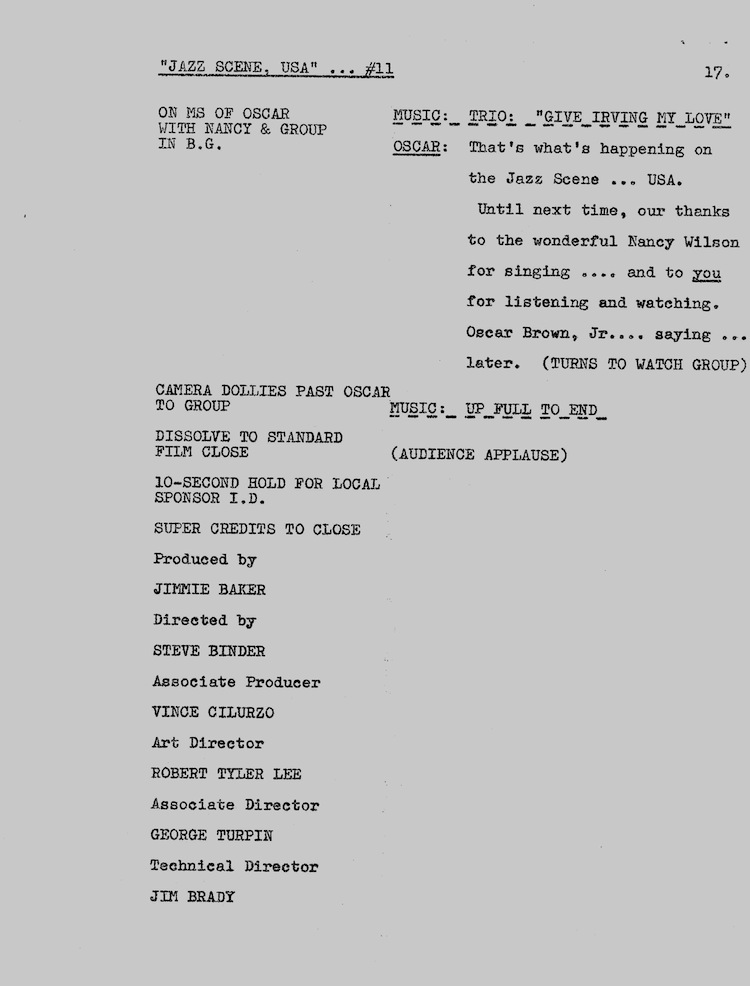
Oscar Brown promoted Nancy Wilson’s Capitol album with Cannonball Adderley, Nancy Wilson/Cannonball Adderley (Capitol T1657), on the show and Ms. Wilson sang HAPPY TALK and NEVER WILL I MARRY from the album.  The album was a bestseller for Capitol and was one of the key elements that cemented Ms. Wilson’s credentials as a jazz artist. 

The following text and photos are from the web site devoted to this pairing of jazz artists:


One night about four years ago in Columbus, Ohio, a willowy young singer took a busman's holiday from her job as vocalist with Rusty Bryant's band to join friends for an evening at the 502 Club-a local jazz emporium where a rather remarkable, up-and-coming alto saxophone player and his swinging combo were appearing.

The girl was Nancy Wilson, and the young man with the horn was Julian "Cannonball" Adderley. Their chance meeting that night will always be well-remembered by both of them.

"Nancy did some tunes with the band that night," Cannonball reflects, "unrehearsed, off-the-top-of-the-head stuff. Even then, this young kid had so much to offer-tone, style, confidence-I felt she just had to go a long way."

Adderley's prophecy of stardom for Nancy has certainly been fulfilled since that first casual get-together just a few short years ago. For today Nancy Wilson is in every way a big-leaguer, a fast-rising young singing star who is just beginning to realize her full potential as an in-person performer as well as a top recording artist for Capitol Records.

"Cannonball has helped me so many times," Nancy remembers. "When I first came to New York, the first person I called when I got off the bus was Cannon."

In New York, Nancy pounded an office typewriter by day and sang by night, the latter in a Bronx jazz spot known as the Blue Morocco. If was here (at Cannonball's urging) that John Levy, former bassist with the famed George Shearing Quintet and now the manager of Shearing, Adderley, and many other stars of jazz, first heard Miss Wilson. One listening was the clincher, and from that evening on Levy took the new singer in tow.

This was the start of many exciting developments for the girl from Columbus, not the least of which was the enthused reaction to her singing by Capitol Records' executive producer, Dave Cavanaugh. Frankly, Cavanaugh simply flipped and signed her right away. Her albums to date have won her a throng of new friends. Critics, their tastes often jaded by an endless parade of new jazz singers, have been unanimous in their praise of Nancy's remarkable phrasing, tone, control, and dynamics.

This album reaches a new high point in the Wilson-Adderley mutual admiration society. Nancy sums it up this way:

"We've wanted to do this for months," she enthused. "But we wanted it to be spontaneous and relaxed. So we waited till the time was right for both of us. We wanted a happy, romping sound. It would be Cannonball's quintet with me fitting in as a sort of easy-going third horn on some nice songs that haven't already been 'heard to death' on records."

Cannonball on alto; Brother Nat Adderley on cornet; Louis Hayes on drums; Sam Jones on bass and Joe Zawinul on piano; that's the quintet whose wide range of jazz ideas and driving appeal reaches (as Time Magazine put it) "to the very fringe of squaredom."

And Nancy's response to their great sound is really something to hear, as she sings with a versatility compounded alternately of savagery and delicacy, displaying the remarkable voice that has already convinced the entire music world that young Nancy Wilson has, to put it mildly, "arrived."

Ren Grevatt

Nancy Wilson, vocal; Lou Levy, piano; Al McKibbon, bass; Kenny Dennis, drums.

The complete show has recently been posted to YouTube:


Production credits:
Host: Oscar Brown, Jr.
Executive Producer: Steve Allen
Producer: Jimmie Baker
Director: Steve Binder
Associate Producer: Vince Cilurzo
Associate Director: George Turpin
Technical Director: Jim Brady
Lighting Director: Leard Davis
Audio: Larry Eaton
Art Director: Robert Tyler Lee
Production Assistant: Penny Stewart
Jazz Consultant: Leonard Feather
Title Films: Grant Velie
Cameras: Bob Dunn, Ed Chaney, Gorman Erickson, Pat Kenny




Thursday, November 29, 2012


JAZZ SCENE U.S.A. #10

THE PETE FOUNTAIN SEXTET


I am in the process of moving my work on this platform to a new home that unites all of my jazz research under one roof. Thank you for looking at my work here at google blogger. I think you will find the new home more user friendly with links and tags to all of my research. This link will take you to this research at the new site where I have updated the links to Jazz Scene USA segments on YouTube.

TUESDAY, SEPTEMBER 4, 1962

CBS TELEVISION CITY, LOS ANGELES, CA

Commentary © James A. Harrod, Copyright Protected; All Rights Reserved


His name was originally Pierre Dewey LaFontaine, Jr., and he was born on White Street between Dumaine and St. Ann in a small Creole French frame house that sat right on the street in New Orleans. His father later changed his own name to Peter Dewey Fountain, and Junior followed suit.

He started playing clarinet as a child at McDonogh 28. As a child, young Pete was very sickly, frequently battling respiratory infections due to weakened lungs. He was given expensive medication but it proved to be not very effective. During a pharmacy visit, Pete's father began a discussion with a neighborhood doctor who was also there shopping and talked with him about his son's condition. The doctor agreed to see the boy the following day. After a short exam, the doctor confirmed the weak lung condition and advised the father to try an unorthodox treatment: purchase the child a musical instrument, anything he has to blow into. The same day, they went to a local music store and given his choice of instruments, Pete chose the clarinet (after first wanting the drums, which his father declined per the doctor's orders). At first Pete was unable to produce a sound from the instrument, but he continued to practice and eventually not only made sounds and eventually music, but greatly improved the health of his lungs.

He took private lessons but also learned to play jazz by playing along with the phonograph records of first Benny Goodman and then Irving Fazola. Early on he played with the bands of Monk Hazel and Al Hirt. With his longtime friend, trumpeter George Girard, Fountain founded The Basin Street Six in 1950.

After this band broke up, four years later Fountain was hired to join the Lawrence Welk orchestra and became well known for his many solos on Welk's ABC television show, The Lawrence Welk Show. Fountain was rumored to have quit when Welk refused to let him "jazz up" a Christmas carol. In an interview, Fountain said he left Welk because "Champagne and bourbon don't mix."

Fountain returned to New Orleans, played with The Dukes of Dixieland, then began leading bands under his own name. He owned his own club in the French Quarter in the 1960s and 1970s. He later acquired "Pete Fountain's Jazz Club" at the Riverside Hilton in downtown New Orleans.
The New Orleans Jazz Club presented "Pete Fountain Day" on October 19, 1959, with celebrations honoring the pride of their city, concluding with a packed concert that evening. His quintet was made up of his studio recording musicians, Stan Kenton's bassist Don Bagley, vibeist Godfrey Hirch, pianist Merle Koch and the double bass drummer Jack Sperling. Fountain brought these same players together in 1963 when they played the Hollywood Bowl. Pete would make the trek to Hollywood many times, appearing on The Tonight Show Starring Johnny Carson 56 times.

Source: Wikipedia entry for Pete Fountain


The Pete Fountain Sextet: Pete Fountain, clarinet; John Probst, piano; Bobby Gibbons, guitar; Godfrey Hirsch, vibes; Morty Corb, bass and Jack Sperling, drums.

Production credits:
Host: Oscar Brown, Jr.
Executive Producer: Steve Allen
Producer: Jimmie Baker
Director: Steve Binder
Associate Producer: Vince Cilurzo
Associate Director: George Turpin
Technical Director: Jim Brady
Lighting Director: Leard Davis
Audio: Larry Eaton
Art Director: Robert Tyler Lee
Production Assistant: Penny Stewart
Jazz Consultant: Leonard Feather
Title Films: Grant Velie
Cameras: Bob Dunn, Ed Chaney, Gorman Erickson, Pat Kenny


Monday, November 12, 2012


JAZZ SCENE U.S.A. #9

TEDDY BUCKNER & HIS DIXIELAND ALL-STARS


I am in the process of moving my work on this platform to a new home that unites all of my jazz research under one roof. Thank you for looking at my work here at google blogger. I think you will find the new home more user friendly with links and tags to all of my research. This link will take you to this research at the new site where I have updated the links to Jazz Scene USA segments on YouTube.

TUESDAY, SEPTEMBER 4, 1962

CBS TELEVISION CITY, LOS ANGELES, CA

Commentary © James A. Harrod, Copyright Protected; All Rights Reserved

Southern California had always supported jazz clubs featuring jazz that was not in the modern vein whether you called it New Orleans, Traditional, Dixieland or Chicago style.  Les Koenig’s GOOD TIME JAZZ label thrived on that segment of the jazz population that supported this kind of jazz.  Teddy Buckner had a long run at the 400 Club, Ted Riley and The Saints similarly were installed at the Hermosa Inn for a long gig, Jack Teagarden could usually be found playing at the Royal Room and when Kid Ory was in town he would be playing to good crowds at the Beverly Cavern.

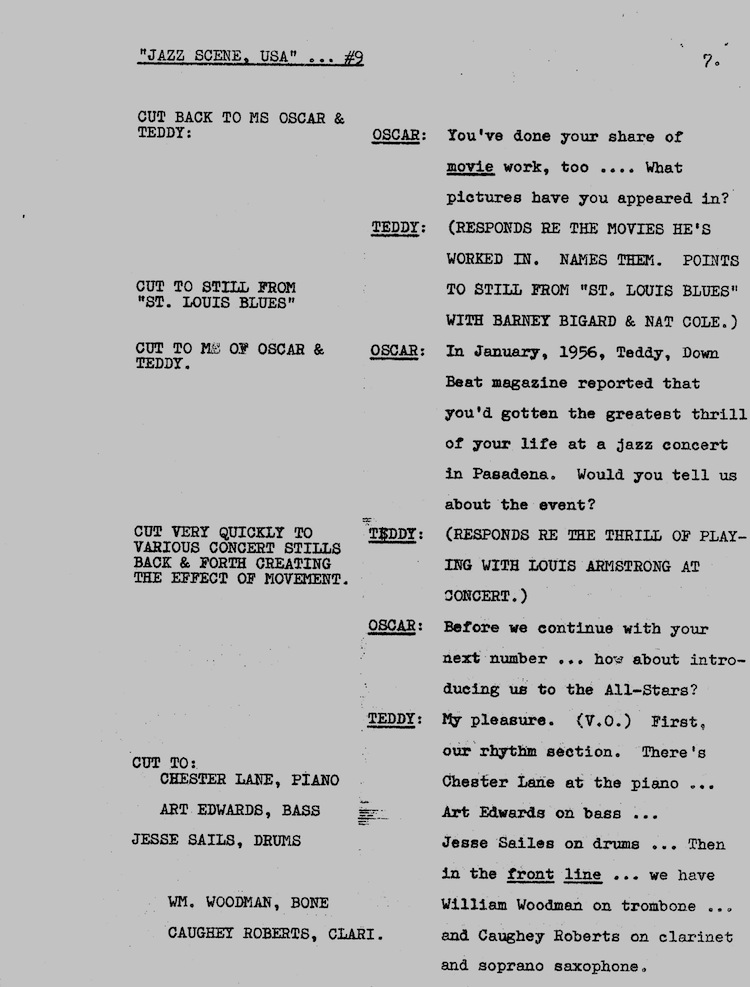
Gene Norman and Frank Bull staged Dixieland Jubilee concerts in Los Angeles, a traditional jazz concert that would bring in groups from New Orleans as well as area groups like Teddy Buckner’s All-Stars and the Firehouse Five Plus Two. Gene Norman also booked Teddy Buckner at his nightclub on Sunset Boulevard, The Crescendo.  Teddy Buckner’s group in this segment of Jazz Scene U.S.A. included Teddy Buckner (cornet, trumpet and flugelhorn); William Woodman (trombone); Caughey Roberts (clarinet, soprano saxophone); Chester Lane (piano); Art Edwards (bass) and Jesse Sailes (drums).

Production credits:

Host: Oscar Brown, Jr.
Executive Producer: Steve Allen
Producer: Jimmie Baker
Director: Steve Binder
Associate Producer: Vince Cilurzo
Associate Director: George Turpin
Technical Director: Jim Brady
Lighting Director: Leard Davis
Audio: Larry Eaton
Art Director: Robert Tyler Lee
Production Assistant: Penny Stewart
Jazz Consultant: John Tynan
Title Films: Grant Velie
Cameras: Bob Dunn, Ed Chaney, Gorman Erickson, Pat Kenny