JAZZ SCENE U.S.A. #12
BARNEY KESSEL
I am in the process of moving my work on this platform to a new home that unites all of my jazz research under one roof. Thank you for looking at my work here at google blogger. I think you will find the new home more user friendly with links and tags to all of my research. This link will take you to this research at the new site where I have updated the links to Jazz Scene USA segments on YouTube.
MONDAY, OCTOBER 1, 1962
CBS TELEVISION CITY, LOS ANGELES, CA
Commentary © James A. Harrod, Copyright Protected; All Rights Reserved
Although Barney Kessel was featured as leader and sideman on several recording sessions in the mid 1940s and early 1950s on other labels, it was his debut album on Contemporary Records titled simply, BARNEY KESSEL (C 2508), that launched his career as one of the most revered jazz guitarists to emerge on the west coast scene. The liner notes written by Nesuhi Ertegun for this debut album, reproduced below, trace the musical evolution that brought Kessel to Los Angeles.

In 1942, an Oklahoma boy named Barney Kessel, not quite twenty, decided to leave home in search of Fame & Fortune in Hollywood. "I went to my mother and told her I was going away. She gave me ten dollars. I said, 'I'm going to California.' She said, 'That's far away,' and gave me another ten dollars. I arrived in Los Angeles with a guitar in one hand, a suitcase in the other, not one cent in my pocket, and not knowing a soul." He went to work as a dishwasher in a drive-in.
Ten years later Barney Kessel was the nation's favorite jazz guitarist. He could look back on a busy career in films and radio, featured appearances with an impressive assortment of name bands, a host of records, concert tours at home and abroad, and, of course, TV.
He was born in Muskogee, Oklahoma, on October 17, 1923. His parents were not only non-musical, they were anti-musical — at least as far as Barney's musical ambitions were concerned. From earliest childhood, though, music became a ruling passion of Barney's life. At twelve he bought his first guitar with a dollar he'd made selling newspapers. He taught himself to play, to read music, and later to arrange and compose.
His interest in jazz started early, and he played with a Negro band in Muskogee when he was only fourteen. Barney's idol, the late Charlie Christian, had been the band's guitarist the year before, and Barney was thrilled to be taking his place. In evaluating his own development as a musician, Barney. says, "These musicians helped me get a jazz feeling it might have taken me years to acquire, and some people never find out. They kept telling me to play like a horn, and -I didn't know what they meant till I heard Charlie Christian's first record with Benny Goodman."
When he was sixteen, Barney finally met Christian, whom he calls "my sole influence." Christian, then twenty-one and a star of the Benny Goodman Sextet, was home in Oklahoma City on a short visit. Barney, although still a high school student, was playing a one-nighter with the University of Oklahoma dance band. In 1939 there were comparatively few electric guitar players about, and Christian, hearing about the youngster playing in the college band, came to the dance. "I was thrilled at meeting him," Barney recalls. "He sat in and played. Later that night he drove me around in his car, took me to a restaurant, talked to me at great length, and was altogether friendly and helpful with advice. That was the only time I ever met him."
The meeting with Christian strengthened Barney's determination to be a professional musician, and in 1942 he made his way to Hollywood. His undeniable talent made it unnecessary for him to be a dish-washer for very long. Hearing about a possible job with an orchestra Chico Marx was forming to take on the road, Barney auditioned. Dozens of more experienced guitarists also auditioned, but Barney got the job. A few days later he found himself playing at the famous Blackhawk in Chicago.
After four months he learned he'd soon be drafted, and he went back home to be with his mother until he was called. But the army rejected him, and he rejoined Chico Marx in New York. He was so impressed by New York he decided to stay there, left Chico, and looked for a job. "I tried out with Les Brown's orchestra and was so nervous I couldn't hold a pick in my hand." He didn't get the job, and after a month he once more joined Chico, now on the way back to California.
Returning from his adventures on the road in 1943 he settled in Los Angeles, joined the local union and almost immediately was working in radio. In the following years he was to play on such network shows as Red Skelton, Jack Carson, Eve Arden, Amos 'n' Andy, etc. Always in demand, Barney often played in big bands (Charlie Barnet, Hal Mclntyre) while they were appearing in Los Angeles; his radio commitments didn't allow him to travel with them. He managed to combine jazz with his commercial work, and in 1944 was the only white musician chosen to appear in the famous jazz movie "Jammin' the Blues."
In August 1945 Artie Shaw offered him a one-year contract, which was so attractive Barney left Los Angeles to travel the country with Shaw. When Shaw disbanded at the end of the year Barney again returned to Hollywood and to radio: first the Jack Smith show, then Bob Crosby's "Club 15" with Jerry Gray's orchestra. He was now at the top commercially, and he continued his busy and varied radio career until an offer came to join Norman Granz' Philharmonic troupe for one year. This meant giving up all the lucrative radio work and going on the road again. But the idea of playing jazz full time appealed to Barney, especially since there was to be a European tour after the American concerts. He made up his mind to "take a holiday for one year," leaving California in the fall of 1952. As a result of the tour, Barney's name became as familiar to European jazz fans as it is here.
In 1953 Barney was back in Los Angeles working as a composer-arranger-musical director for the Bob Crosby TV show, a half-hour coast-to-coast program five times a week. When he isn't working on the TV program he teaches, records, makes transcriptions and appears at jazz concerts. In 1953 he signed an exclusive recording contract with CONTEMPORARY.
Barney is fully aware of the new directions of jazz in the post-war years, but it is difficult to identity him with any one specific trend because his playing is deeply rooted in the basic jazz tradition: the blues he heard as a boy in Oklahoma, the swing he learned on his first band job, and the modern sounds of the West Coast School, with which he made contact in the Fifties.
Nesuhi Ertegun
Liner notes to Contemporary Records C2508

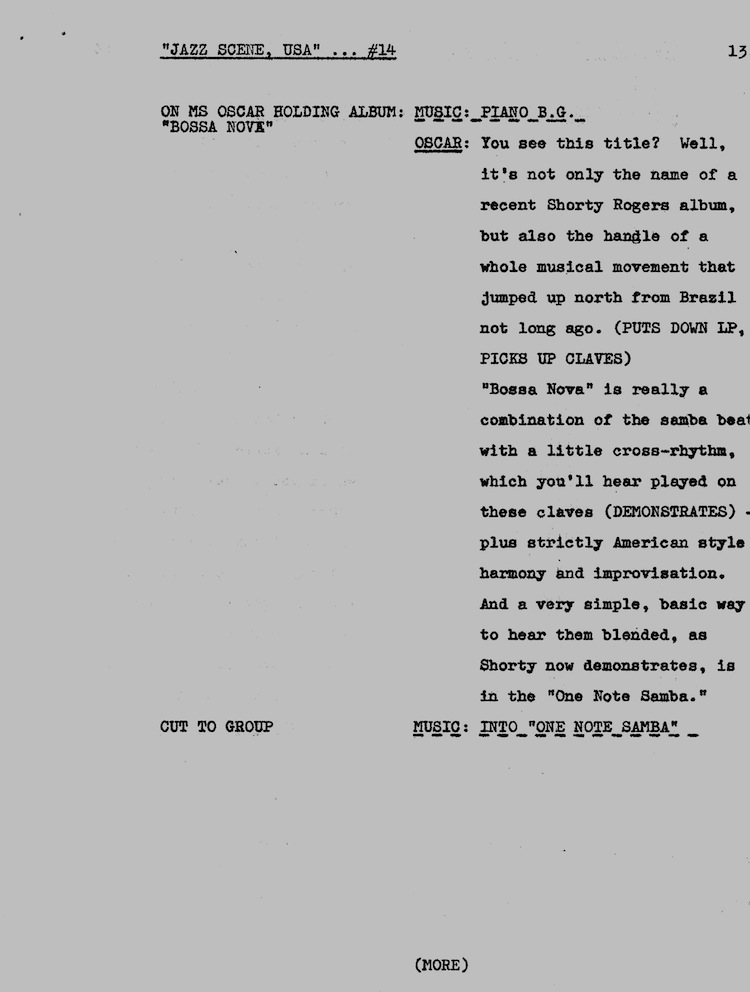
In the early 1960s Barney Kessel recorded several albums for the Reprise label, Kessel/Jazz: Contemporary Latin Rhythms (Reprise R(S)6073), Breakfast At Tiffanys / Barney Kessel & His Men (Reprise R(S)6019) and BOSSA NOVA /Barney Kessel Plus Big Band (Reprise R(S)6049). Oscar Brown, Jr. features the latter album on the program, holding a copy before the camera noting that the two musicians accompanying Kessel on the show are not on the album and then introduces Buddy Woodson on bass and Stan Levey on Drums.
The entire Jazz Scene U.S.A. show with the Barney Kessel Trio is currently available on youtube for viewing, most likely recorded by a European fan when the series was broadcast overseas.
The Barney Kessel Trio: Barney Kessel, guitar; Buddy Woodson, bass and Stan Levey, drums.
Production credits:
Host: Oscar Brown, Jr.
Executive Producer: Steve Allen
Producer: Jimmie Baker
Director: Steve Binder
Associate Producer: Penny Stewart
Associate Director: George Turpin
Technical Director: Jim Brady
Lighting Director: Leard Davis
Audio: Larry Eaton
Art Director: Robert Tyler Lee
Jazz Consultant: John Tynan
Title Films: Grant Velie
Cameras: Bob Dunn, Ed Chaney, Gorman Erickson, Pat Kenny