Wednesday, June 12, 2013

JAZZ SCENE U.S.A. #21


MARK MURPHY / JIMMY ROWLES QUARTET


I am in the process of moving my work on this platform to a new home that unites all of my jazz research under one roof. Thank you for looking at my work here at google blogger. I think you will find the new home more user friendly with links and tags to all of my research. This link will take you to this research at the new site where I have updated the links to Jazz Scene USA segments on YouTube.

MONDAY, NOVEMBER 12, 1962

CBS TELEVISION CITY, LOS ANGELES, CA

Commentary © James A. Harrod, Copyright Protected; All Rights Reserved

The following brief biography from Wikipedia supplies essential details concerning Murphy’s background up until his appearance on Jazz Scene USA

Born in Syracuse, New York in 1932, Murphy was raised in a musical family, his parents having met as members of the local Methodist Church choir. He grew up in the nearby small town of Fulton, New York where his grandmother and then his aunt were the church organists. Opera was also popular in the Murphy home. He started piano lessons at the age of seven.

Murphy joined his brother's jazz dance band as the singer when a teenager, citing influences from Nat "King" Cole, June Christy, Anita O'Day, and Ella Fitzgerald. Jazz piano legend Art Tatum was also an influence.

Murphy graduated from Syracuse University in 1953, majoring in Music and Drama. University life included performing on campus and also in a club – piano and singing.

In 1954, Murphy moved to New York City, working part-time as an actor and singer. He appeared in productions for the Gilbert and Sullivan Light Opera Company and a musical version for TV of Casey at the Bat. Also, he twice took second place at the Apollo Theatre amateur contests.

Murphy was eventually introduced to record producer Milt Gabler, who was an artist and repertoire director (A & R) for Decca. Gabler’s reputation was extensive, having previously recorded Jack Teagarden, Bud Freeman, Pee Wee Russell, Lester Young, Coleman Hawkins, Edmond Hall, Hot Lips Page, and Billie Holiday. He was also working with Ella Fitzgerald and Bill Haley & His Comets.


Gabler compared Murphy to Mel Tormé and predicated that his impact would “scare Frank Sinatra”. His resulting debut recording was Meet Mark Murphy (1956), followed closely by Let Yourself Go (1957). 


In 1958 Murphy moved to Los Angeles and recorded for Capitol, but returned to New York in the early '60s and recorded the now classic jazz album Rah (1961) on Riverside Records, performing Angel Eyes, a famous version of Horace Silver's "Doodlin',and On Green Dolphin Street, featuring legendary jazz players Bill Evans, Clark Terry, Urbie Green, Blue Mitchell, and Wynton Kelly. His favorite recording to date, That's How I Love the Blues soon followed. In 1963, Murphy hit the charts across the country with his single of Fly Me To the Moon and was voted "New Star of the Year" in Down Beat Magazine's Reader's Poll.

During his sojourn in Los Angeles Mark Murphy made two appearances on Stars of Jazz, the channel 7 KABC series that was produced by Jimmie Baker.  He was backed by Shelly Manne & His Men on his first Stars of Jazz date and by the Candoli brothers plus Jimmy Rowles, Red Mitchell, Mel Lewis and Howard Roberts on his second Stars of Jazz appearance.  

The Candoli brothers would continue to back Mark Murphy on some of his albums for Capitol Records and Jimmy Rowles backed Murphy on all three of his Capitol LPs.  The Jimmy Rowles group was a natural choice to back Murphy for his Jazz Scene USA appearance.  Bill Holman wrote the arrangements for all three Capitol albums.

Mark Murphy, vocal accompanied by Jimmy Rowles, piano; Red Mitchell, bass; Mel Lewis, drums and Steve Geradino, bongos.

Production credits: 
Host: Oscar Brown, Jr. 
Executive Producer: Steve Allen 
Producer: Jimmie Baker 
Director: Steve Binder 
Associate Producer: Penny Stewart 
Associate Director: George Turpin 
Technical Director: Dick Hall 
Lighting Director: Leard Davis 
Audio: Larry Eaton 
Art Director: Robert Tyler Lee 
Jazz Consultant: Leonard Feather 
Title Films: Grant Velie 
Cameras: Bob Dunn, Ed Chaney, Gorman Erickson, Pat Kenny


Sunday, May 5, 2013


JAZZ SCENE U.S.A. #20

CURTIS AMY / PAUL BRYANT QUINTET


I am in the process of moving my work on this platform to a new home that unites all of my jazz research under one roof. Thank you for looking at my work here at google blogger. I think you will find the new home more user friendly with links and tags to all of my research. This link will take you to this research at the new site where I have updated the links to Jazz Scene USA segments on YouTube.

MONDAY, OCTOBER 29, 1962

CBS TELEVISION CITY, LOS ANGELES, CA

Commentary © James A. Harrod, Copyright Protected; All Rights Reserved

Jimmie Baker and Steve Allen tapped the Curtis Amy / Paul Bryant Quintet for the 20th segment of Jazz Scene USA. Both Curtis and Bryant had recently recorded for Dick Bock’s Pacific Jazz label and were constantly booked into the top jazz clubs operating in Los Angeles at the time.  The following liner notes from their Pacific Jazz album, The Blues Message (PJ-9),  supply the background for their emergence on the label:


The small clubs around LA are producing a continuous flow of rising young jazz stars, and veterans as wel. Realizing this, Richard Bock, President of Pacific Jazz, has showcased some of the better ones to the jazz world on his label. This album exemplifies Bock's foresight—for the performers gathered for this record date had previously played at various clubs around town. After recording this album they found much to their delight, that they functioned well as a quintet, and deciding that a good thing must not be dissolved—will stay together as a quintet and call 'Dynamite Jackson's' their home.


Dynamite Jackson's, on Adams Blvd., in the heart of the Crenshaw District of Los Angeles is a small, intimate club which caters to a predominately Negro clientele—and is a summit meeting ground for some of the top jazz combos in this town, or any other town for that matter. It was at Dynamite's that Bock first came in contact with Curtis Amy, one of the leaders on this record date. Also playing with Curtis was Roy Brewster, who is the valve trombonist. Out of this casual meeting developed an idea, which when it materialized became the foundation for this album, and a 'cooking' new group destined for great things.


Curtis, a wailing tenor saxophonist, was born October 11, 1929 in Houston, Texas. He started his musical training at the tender age of four with clarinet lessons. After picking up a degree in music at Kentucky State College, he Journeyed to Louisville, Kentucky to a club named the Top Hat. The 'gig' at the Top Hat is what Curtis considers his first big break. From there he toured the midwest circuit for a couple of years, and then comes an interruption in his musical career—when he turned his talents to a more scholarly endeavor—Joining the ranks of the educators for a couple of years—teaching school in Jackson, Tennessee. In 1955 Curtis came to LA where he has since remained. Although he lists most of LA'S top clubs in his credits, as well as recording sessions with the jazz 'giant' Dizzy Gillespie and Perry Lee, this is Curtis' first LP as a leader.

Curtis carries himself very well in his first effort as a leader. He is a hard driving tenor saxophonist who plays jazz in a bluesy and very funky vein. There is tenacity in his musical range—although you are always aware of a hard-driving message—which is evident in his ballad renditions, which remind you sometimes of a man walking on a tightrope. This Is The Blues, Going Down and Catch Me A Woman, Blues Message, are original tunes written by
Curtis.

Roy Brewster has also been a fixture on the scene at Dynamite's. Roy was born in Lake Charles, Louisiana, March 17, 1934.  Although he is now a very accomplished valve trombonist, Roy started his musical training at fifteen years old with the trumpet. He came to Los Angeles at a very early age, and finished his schooling at Jefferson High School. After graduation Roy toured on the road with various rock 'n' roll groups, before joining forces with Curtis in 1959. This is his first recording session.

Bock, the imaginative idea man, kept thinking of possible combinations that would click on this record date, and hit up on the idea of Paul Bryant, who was putting in his work at Mardi's—a top flight LA jazz club. Paul was selected as co-leader for the session, a capacity which he ably fills. The twenty-seven year old native of New Jersey has been in show business most of his life, Paul started taking piano lessons at the age of four. Most of his younger years were devoted to motion pictures, TV, and stage work. In 1958, while working with the Claude McLin Trio at Dynamite's, Paul switched from piano to organ. The reason for the switch: 'better expression.' When asked to clarify that statement, the hard-driving Paul, who's every statement on organ is clarity at first hearing—stated: "there is just so much you can do on piano, but so much more you can do on organ."

James 'Jimmy' Miller was timekeeping on drums at Mardi's for Paul when discovered. Jimmy has worked in the LA area since 1947, and was in the rhythm section when Curtis was picking up his paycheck at Mardi’s. He was born May 15, 1930 in Akron, Ohio. At sixteen years old he started playing drums. T-Bone Walker gave him his first big break, and the young drummer toured the country with the famous blues guitarist. Record sessions are not new to Jimmy, having worked with such well known names as 'Wild' Bill Davis, Jimmy Witherspoon, Ernie Freeman, et al.

Clarence S. Jones is the bassist. Clarence was born December 27, 1926, in Los Angeles, He graduated from Jefferson High School (Roy's alma mater), and studied music at Westlake College of Music (Hollywood). Clarence is a veteran sideman who has played in most of the LA clubs at one time or another. At various times he has put in stints with such west coast 'giants' as Shorty Rogers, Harold Land, Art Pepper, et al. Just prior to this recording session, Clarence returned from New York where he worked with a group led by Shorty Rogers and Harold Land. Also among the bassist's credits is a LP done with Kenny Dorham.

Now Bock had the ingredients for a first rank 'cookingsession. So now you can hear what I heard—and feltand knew—that this quintet has what it takes. The tunes are mostly blues, with a soul-searching message that is evident throughout. But listen, and dig. And when you do I know you will want to drop by Dynamite's and hear some of this 'blues preaching.' So without further ado, may I have the pleasure of introducing to you what I know you will term a revelation - A funky, hard-driving quintet led by Curtis Amy and Paul Bryant.

EARL ANTHONY
(Los Angeles Columnist)
Liner notes - PJ-9 
© EMI Capitol Music

Curtis Amy was the subject of an article in Down Beat written by John Tynan that appeared in the December 6, 1962 issue.  The host of Jazz Scene USA, Oscar Brown, Jr. was on the cover and also received a lengthy profile in the same issue of Down Beat. 


Curtis Amy and Paul Bryant recorded for Pacific Jazz in other ensemble settings as well and were featured jazz artists in the new Pacific Jazz line.


The quintet that recorded The Blues Message, did not appear on this segment of Jazz Scene USA.  Bob Whitlock replaced Clarence S. Jones on bass and Tony Bazley occupied the drum chair in place of Jimmy Miller.

The Curtis Amy / Paul Bryant Quintet: Curtis Amy, tenor saxophone; Paul Bryant, organ; Roy Brewster, valve trombone; Bob Whitlock, bass and Tony Bazley, drums.

Production credits: 
Host: Oscar Brown, Jr. 
Executive Producer: Steve Allen 
Producer: Jimmie Baker 
Director: Steve Binder 
Associate Producer: Penny Stewart 
Associate Director: George Turpin 
Technical Director: Dick Hall 
Lighting Director: Leard Davis 
Audio: Larry Eaton 
Art Director: Robert Tyler Lee 
Jazz Consultant: John Tynan 
Title Films: Grant Velie 
Cameras: Bob Dunn, Ed Chaney, Gorman Erickson, Pat Kenny


Monday, April 22, 2013


JAZZ SCENE U.S.A. #19

OSCAR BROWN, JR.


I am in the process of moving my work on this platform to a new home that unites all of my jazz research under one roof. Thank you for looking at my work here at google blogger. I think you will find the new home more user friendly with links and tags to all of my research. This link will take you to this research at the new site where I have updated the links to Jazz Scene USA segments on YouTube.

MONDAY, OCTOBER 29, 1962

CBS TELEVISION CITY, LOS ANGELES, CA


Commentary © James A. Harrod, Copyright Protected; All Rights Reserved

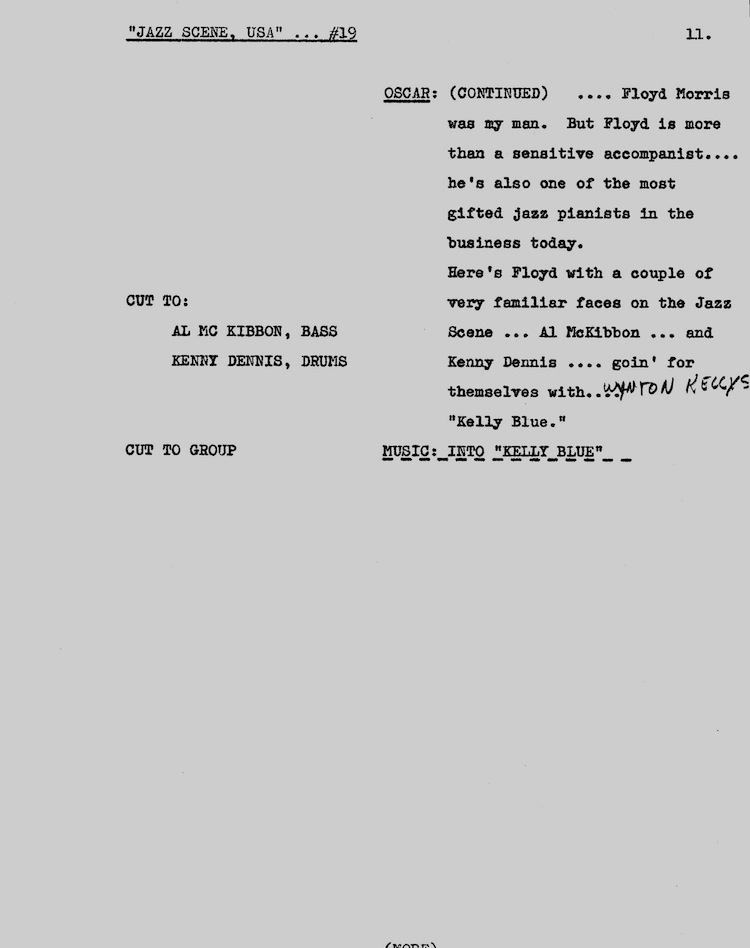
The nineteenth program taped for Steve Allen’s Jazz Scene USA featured the host of the series, Oscar Brown, Jr., accompanied by the Floyd Morris Trio (Floyd Morris (piano), Al McKibbon (bass) and Kenny Dennis (drums).  The brief biography below is taken from the wikipedia entry for Oscar Brown, Jr.


Oscar Brown, Jr (October 10, 1926 – May 29, 2005) was an American singer, songwriter, playwright, poet, civil rights activist, and actor. He ran unsuccessfully for office in both the Illinois state legislature and the U.S. Congress. Brown wrote at least 1,000 songs (only 125 have been published), twelve albums, and over a dozen musical plays.

Early life
Born and raised on the south side of Chicago, he was named after his father Oscar Brown, Sr., a successful attorney and real estate broker. His singing debut was on the radio show Secret City at the age of 15. Brown attended Englewood High School in Chicago, the University of Wisconsin–Madison, and Lincoln University (Pennsylvania) but did not obtain a degree. He also served a stint in the U.S. Army.

Music
Brown's father had intended for him to follow in his footsteps and become a practicing lawyer. While he did help his father at his practice, he ventured off into other careers, such as advertising and serving in the army in the mid-1950s and writing songs. When Mahalia Jackson recorded one of his songs, he began to focus on a career in music. His first major contribution to a recorded work was a collaboration with Max Roach, We Insist!, which was an early record celebrating the black freedom movement in the United States. Columbia Records signed Brown as a solo artist, who was by now in his mid-thirties and married with five children.

In 1960, Brown released his first LP, Sin & Soul, recorded from June 20 to October 23, 1960. Printed on the cover of the album were personal reviews by well-known celebrities and jazz musicians of the time, including Steve Allen, Lorraine Hansberry, Nat Hentoff, Dorothy Killgallen, Max Roach and Nina Simone (Simone would later cover his "Work Song" and Steve Allen would later hire him for his Jazz Scene USA television program). The album is regarded as a "true classic" for openly tackling the experiences of African-Americans with songs such as "Bid 'Em In" and "Afro Blue".

Sin & Soul is also significant because Brown took several popular jazz instrumentals and combined them with self-penned lyrics on songs like "Dat Dere", "Afro Blue" and "Work Song". This began a trend that would continue with several other major jazz vocalists. Jon Hendricks, for example, three years later composed lyrics for the Mongo Santamaría song "Yeh Yeh" (later a hit for Georgie Fame). Bob Dorough similarly composed lyrics for Mel Tormé's version of "Comin' Home Baby!" and musicians Larry Williams and Johnny "Guitar" Watson would also go on to compose lyrics for Cannonball Adderley's "Mercy, Mercy, Mercy" (the music composed by Joe Zawinul, Adderley's pianist) for Marlena Shaw. Several of the tracks from Sin & Soul were embraced by the 1960s Mod movement, such as "Humdrum Blues", "Work Song" and "Watermelon Man".

Sin & Soul was followed by Between Heaven and Hell (1962). The success of Sin & Soul meant that much more money was spent on production and Quincy Jones and Ralph Burns were bought in to handle the arrangements.

However, Brown was soon to fall down the pecking order at Columbia following a rearrangement of the management at the company. His third album was notable for the lack of any self-composed songs, and Columbia was having a hard time packaging Brown as an artist. They were unsure whether he was suited to middle-of-the-road/easy listening nightclubs or alternatively should be presented as a jazz artist.

He was given much more creative freedom for his fourth album, Tells It Like It Is (1963) and he was back to his creative best, composing songs such as "The Snake", which became a Northern Soul classic when it was covered by Al Wilson, and has featured on several adverts. Despite this return to form, and having been told by the new head of Columbia that he was high on the company's priorities, his contract at Columbia was not renewed.

Stage and television
He attempted to mount a major musical stage show in New York City called Kicks & Co. around 1960. Host Dave Garroway turned over an entire broadcast of the Today show to Brown to perform numbers from the show and try to raise the necessary funds to launch it on the stage. Kicks & Co. is set on an all-African-American college campus in the American South during the early days of attempted desegregation. The character Mr. Kicks is an emissary of Satan, sent to try to derail these efforts in which the play's protagonist, Ernest Black, has become involved.

This was the first of several theatrical endeavors by Brown, and like all of them, the public was not won over sufficiently to allow financial success, despite acclaim by some critics. His longest-running relative success, thanks to the participation of Muhammad Ali, was Big-Time Buck White. Another notable musical show, Joy, saw two incarnations (in 1966 and 1969) and again addressed social issues. Appearing with Brown were his wife, Jean Pace, and the Brazilian singer/accordionist Sivuca. RCA released the original cast recording around 1970; it is long out of print.

In 1962, he worked on the Westinghouse syndicated television program, Jazz Scene USA, produced by Steve Allen. Brown was he show's presenter and it featured a new musical guest each week.

Family
Brown's son, Oscar "BoBo" Brown III, was an instrumental musician who died in a car crash. His daughter, Maggie Brown, is a singer, songwriter, actress, educator and mom of three. Along with Africa Brown, these three out of seven children carry out his legacy in singing and acting.

Humanitarian work
He founded The Oscar Brown, Jr. H.I.P. Legacy Foundation to carry on his humanitarian work.

Death and musical legacy
Brown died in Chicago, from complications of osteomyelitis in May 2005, aged 78.
Brown's lyrics and original compositions have been performed by a variety of other artists. "Somebody Buy Me a Drink", a track from Sin & Soul, was covered by David Johansen and the Harry Smiths on their eponymous first album. Nina Simone popularized Brown's lyrics to "Work Song" and "Afro Blue," as well as his song "Bid 'Em In." Brown's "Afro Blue" lyrics have since been performed by numerous contemporary jazz vocalists, including Dianne Reeves, Dee Dee Bridgewater, and Lizz Wright. Vocalist Karrin Allyson has cited Brown as a particular inspiration, and has performed his compositions on several of her albums. Brown was scheduled to contribute new lyrics to Allyson's 2006 album, Footprints, but died before the project was complete; Allyson instead recorded Brown's songs "A Tree and Me" and "But I Was Cool" as a tribute. Brown's work has also been the focus of full-length tribute albums by lesser-known jazz artists, including cabaret singer Linda Kosut and Brown's own daughter, Maggie Brown.

Oscar Brown, Jr. Interview NPR


Oscar Brown, Jr. (vocal); Floyd Morris (piano); Al McKibbon (bass); Kenny Dennis (drums).

Production credits: 
Host: Oscar Brown, Jr.  
Executive Producer: Steve Allen  
Producer: Jimmie Baker  
Director: Steve Binder  
Associate Producer: Penny Stewart  
Associate Director: George Turpin  
Technical Director: Dick Hall  
Lighting Director: Leard Davis  
Audio: Larry Eaton  
Art Director: Robert Tyler Lee  
Jazz Consultant: John Tynan  
Title Films: Grant Velie  
Cameras: Bob Dunn, Ed Chaney, Gorman Erickson, Pat Kenny